


Hand flat frame printing: The mark of a rare textile craft
In the world of textiles, some techniques go far beyond execution.
They belong to the hand.
To the eye.
To time.
Hand flat frame printing belongs to that rare category of craftsmanship that cannot be reduced to a simple method. It reflects a true culture of precision, patience and exacting standards.
At Beauvillé, this savoir-faire is part of a tradition in which the beauty of a fabric never lies in its pattern alone. It lies in what gives it depth, vibration and presence — in what, at first glance, distinguishes a simply printed textile from one that feels truly alive.
Because a motif only fully exists when it meets the accuracy of the hand.
The luxury of a motif is not found in the design alone
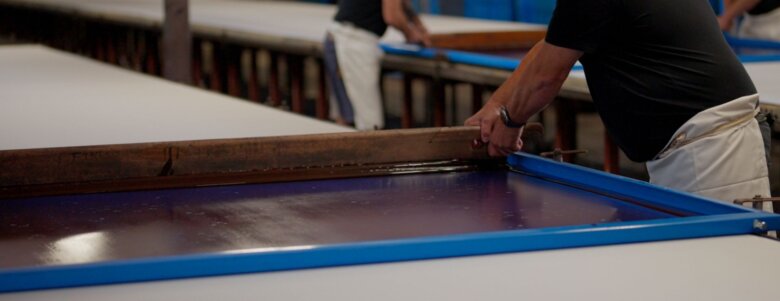
A remarkable decorative pattern is never born from a single line.
It is born from balance.
The balance of composition, certainly.
But also of color, density, rhythm and material.
That is where the singularity of hand flat frame textile printing lies: in its ability to give a pattern a presence that simple reproduction alone cannot achieve.
Every detail finds its exact place.
Every shade reveals its depth.
Every layer responds to the one before it.
It is no longer just printing.
It becomes a visual construction.
A craft where precision becomes a language
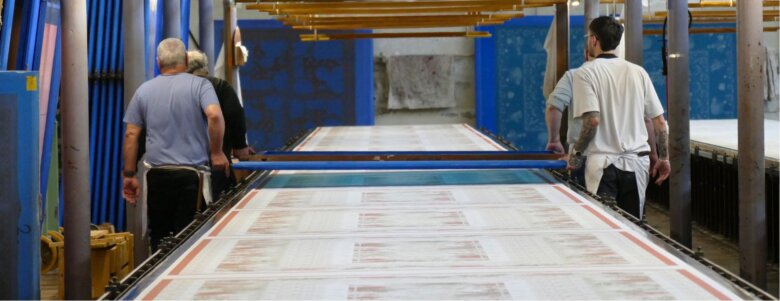
Flat frame printing consists of applying each color of a design onto the fabric one by one, using separate frames.
When carried out by hand, the process requires a particular mastery: alignment, consistency, pressure, rhythm. Nothing is left to approximation.
Each pass depends on the accuracy of the gesture.
Each color demands a perfect reading of the design.
Each stage contributes to the final balance of the textile.
In this discipline of detail, the hand is never secondary.
It is essential.
And it is precisely this human dimension — this quiet rigor — that gives the fabric its singular character.
The depth of a textile often lies in what cannot be seen immediately
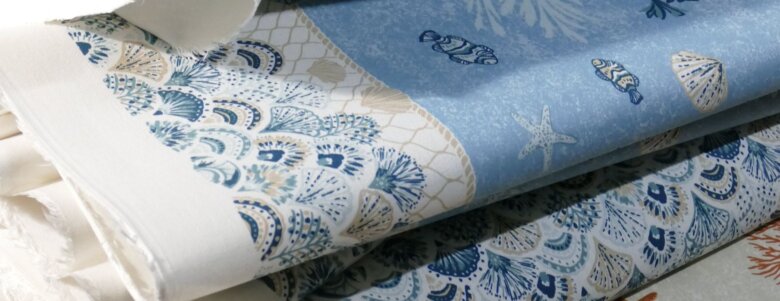
What gives a textile its nobility does not always appear as an obvious, dramatic statement.
In the finest fabrics, there is often a certain restraint.
A richness that does not seek to impose itself, but gradually reveals itself: in the subtlety of a contour, in the steadiness of a color, in the way a motif catches the light.
Hand printing on fabric gives rise to this particular quality of presence.
A quiet intensity.
An almost tactile depth.
A visual density that the eye perceives before it can fully name.
This is often where true luxury resides: not in what is demonstrated, but in what is felt.
Time as a condition of excellence
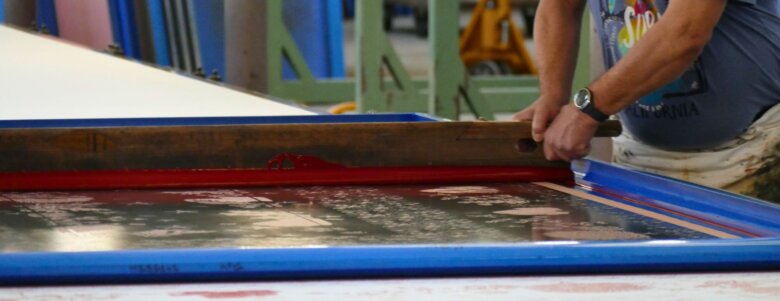
Some forms of craftsmanship cannot be accelerated without losing their truth.
Hand flat frame printing is one of them.
It requires time — not as a constraint, but as a condition.
Time for adjustment.
Time for control.
Time for exact execution.
In a world shaped by speed and uniformity, this fidelity to a slower rhythm gives the textile a particular value. It inscribes something rarer into the fabric itself: attention.
And in the world of the home, attention changes everything.
A decorative art before it is simply a textile
At Beauvillé, table linens have never been conceived as simple entertaining accessories.
They belong to an art of living in which the table becomes décor, atmosphere and memory. A tablecloth does not merely cover a surface — it sets a tone, creates a presence, composes a scene.
Within this vision, hand flat frame printing finds its full meaning. It does not simply reproduce a motif. It gives it an intensity capable of moving through seasons, occasions and years.
This is how certain creations become more than home linens.
They become signatures.
What the hand leaves behind in the fabric
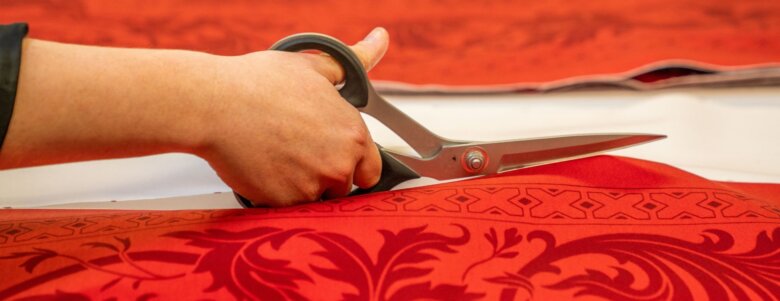
There is something in exceptional craftsmanship that goes beyond technique.
A form of transmission.
A way of making that engages both precision and sensitivity.
A loyalty to a gesture that, repeated with discipline, ultimately imprints more than a pattern — it leaves a trace.
The trace of a house.
Of an eye.
Of a certain idea of beauty.
Perhaps that is what we recognize, in the end, in the most singular textiles: not simply their appearance, but the imprint of care they carry within them.
Because the finest fabrics never tell the story of decoration alone. They tell the story of a hand.